Launched in April 2006 as a statistical machine translation service, it used United Nations and European Parliament documents and transcripts to gather linguistic data. Rather than translating languages directly, it first translates text to English and then pivots to the target language in most of the language combinations it posits in its grid, with a few exceptions including Catalan-Spanish. During a translation, it looks for patterns in millions of documents to help decide which words to choose and how to arrange them in the target language. Its accuracy, which has been criticized and ridiculed on several occasions, has been measured to vary greatly across languages. Originally only enabled for a few languages in 2016, GNMT is now used in all 109 languages in the Google Translate roster as of January 2022. Google Translate produces approximations across languages of multiple forms of text and media, including text, speech, websites, or text on display in still or live video images.

For some languages, Google Translate can synthesize speech from text, and in certain pairs it is possible to highlight specific corresponding words and phrases between the source and target text. Results are sometimes shown with dictional information below the translation box, but it is not a dictionary and has been shown to invent translations in all languages for words it does not recognize. If "Detect language" is selected, text in an unknown language can be automatically identified.

In the web interface, users can suggest alternate translations, such as for technical terms, or correct mistakes. These suggestions may be included in future updates to the translation process. If a user enters a URL in the source text, Google Translate will produce a hyperlink to a machine translation of the website.

Users can save translation proposals in a "phrasebook" for later use. For some languages, text can be entered via an on-screen keyboard, through handwriting recognition, or speech recognition. It is possible to enter searches in a source language that are first translated to a destination language allowing one to browse and interpret results from the selected destination language in the source language. Due to differences between languages in investment, research, and the extent of digital resources, the accuracy of Google Translate varies greatly among languages. Some languages produce better results than others. Most languages from Africa, Asia, and the Pacific, tend to score poorly in relation to the scores of many well-financed European languages, Afrikaans and Chinese being the high-scoring exceptions from their continents.

No languages indigenous to Australia or the Americas are included within Google Translate. Higher scores for European can be partially attributed to the Europarl Corpus, a trove of documents from the European Parliament that have been professionally translated by the mandate of the European Union into as many as 21 languages. A 2010 analysis indicated that French to English translation is relatively accurate, and 2011 and 2012 analyses showed that Italian to English translation is relatively accurate as well. However, if the source text is shorter, rule-based machine translations often perform better; this effect is particularly evident in Chinese to English translations. While edits of translations may be submitted, in Chinese specifically one cannot edit sentences as a whole.

Instead, one must edit sometimes arbitrary sets of characters, leading to incorrect edits. Formerly one would use Google Translate to make a draft and then use a dictionary and common sense to correct the numerous mistakes. As of early 2018 Translate is sufficiently accurate to make the Russian Wikipedia accessible to those who can read English. The quality of Translate can be checked by adding it as an extension to Chrome or Firefox and applying it to the left language links of any Wikipedia article. It can be used as a dictionary by typing in words.

One can translate from a book by using a scanner and an OCR like Google Drive, but this takes about five minutes per page. Although Google deployed a new system called neural machine translation for better quality translation, there are languages that still use the traditional translation method called statistical machine translation. It is a rule-based translation method that utilizes predictive algorithms to guess ways to translate texts in foreign languages. It aims to translate whole phrases rather than single words then gather overlapping phrases for translation.

Moreover, it also analyzes bilingual text corpora to generate statistical model that translates texts from one language to another. In November 2016, Google transitioned its translating method to a system called neural machine translation. It uses deep learning techniques to translate whole sentences at a time, which has been measured to be more accurate between English and French, German, Spanish, and Chinese.

No measurement results have been provided by Google researchers for GNMT from English to other languages, other languages to English, or between language pairs that do not include English. As of 2018, it translates more than 100 billion words a day. Before October 2007, for languages other than Arabic, Chinese and Russian, Google Translate was based on SYSTRAN, a software engine which is still used by several other online translation services such as Babel Fish .
From October 2007, Google Translate used proprietary, in-house technology based on statistical machine translation instead, before transitioning to neural machine translation. Current statusActiveGoogle Translate is a multilingual neural machine translation service developed by Google to translate text, documents and websites from one language into another. It offers a website interface, a mobile app for Android and iOS, and an API that helps developers build browser extensions and software applications. As of January 2022, Google Translate supports 109 languages at various levels and as of April 2016, claimed over 500 million total users, with more than 100 billion words translated daily. Google has crowdsourcing features for volunteers to be a part of its "Translate Community", intended to help improve Google Translate's accuracy. Volunteers can select up to five languages to help improve translation; users can verify translated phrases and translate phrases in their languages to and from English, helping to improve the accuracy of translating more rare and complex phrases.
In August 2016, a Google Crowdsource app was released for Android users, in which translation tasks are offered. First, Google will show a phrase that one should type in the translated version. Second, Google will show a proposed translation for a user to agree, disagree, or skip. Third, users can suggest translations for phrases where they think they can improve on Google's results. Tests in 44 languages show that the "suggest an edit" feature led to an improvement in a maximum of 40% of cases over four years, while analysis across the board shows that Google's crowd procedures often reduce erroneous translations.
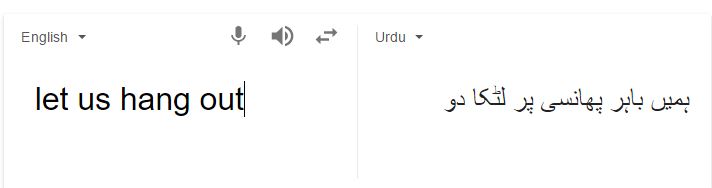
When used as a dictionary to translate single words, Google Translate is highly inaccurate because it must guess between polysemic words. Most common English words have at least two senses, which produces 50/50 odds in the likely case that the target language uses different words for those different senses. The odds are similar from other languages to English. The accuracy of single-word predictions has not been measured for any language. When Google Translate does not have a word in its vocabulary, it makes up a result as part of its algorithm.
Google Translate is not as reliable as human translation. Accuracy decreases for those languages when fewer of those conditions apply, for example when sentence length increases or the text uses familiar or literary language. For many other languages vis-à-vis English, it can produce the gist of text in those formal circumstances. Human evaluation from English to all 102 languages shows that the main idea of a text is conveyed more than 50% of the time for 35 languages. For 67 languages, a minimally comprehensible result is not achieved 50% of the time or greater.
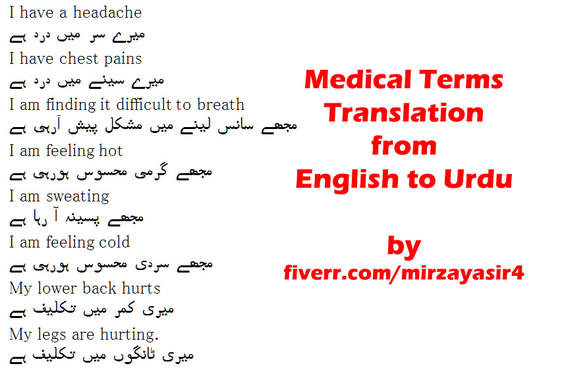
A few studies have evaluated Chinese, French, German, and Spanish to English, but no systematic human evaluation has been conducted from most Google Translate languages to English. But in November 2016, Google announced the transition to a neural machine translation premise - a "deep learning" practice that saw the service comparing whole sentences at a time from a broader range of linguistic sources. You need an online machine translator to quickly translate English to Roman Urdu.

We hope that our English to Roman Urdu translator can simplify your process of translation of English text, messages, words, or phrases. If you type English phrase "Hello my friend!" in input text box and click Translate Button than it is translated to Roman Urdu as "ہیلو میرے دوست!". You can either type your English text or copy and paste your text in the above box and hit the translate button and you will instantly get Roman Urdu translation right away. In May 2014, Google acquired Word Lens to improve the quality of visual and voice translation. It is able to scan text or a picture using the device and have it translated instantly.

Moreover, the system automatically identifies foreign languages and translates speech without requiring individuals to tap the microphone button whenever speech translation is needed. Originally, Google Translate was released as a statistical machine translation service. The input text had to be translated into English first before being translated into the selected language. Since SMT uses predictive algorithms to translate text, it had poor grammatical accuracy. Despite this, Google initially did not hire experts to resolve this limitation due to the ever-evolving nature of language.

Our tool uses machine translation powered by Google Api, Microsoft Translate, and Yandex. This tool lets users to get the best English to Roman Urdu translation, it can translate English to 114 languages. If you need more accurate human English to Roman Urdu translation service, use Translate from English to Roman Urdu. In January 2015, the apps gained the ability to propose translations of physical signs in real time using the device's camera, as a result of Google's acquisition of the Word Lens app.

The feature was subsequently renamed Instant Camera. The technology underlying Instant Camera combines image processing and optical character recognition, then attempts to produce cross-language equivalents using standard Google Translate estimations for the text as it is perceived. Urdu speech translation service is provided by both Microsoft and Google. They both use their own cognitive services to translate spoken words and phrases into a language of your choice.
For some languages, you will hear the translation spoken aloud. Another natural question is whether Google Translate's use of neural networks—a gesture toward imitating brains—is bringing us closer to genuine understanding of language by machines. This sounds plausible at first, but there's still no attempt being made to go beyond the surface level of words and phrases. All sorts of statistical facts about the huge databases are embodied in the neural nets, but these statistics merely relate words to other words, not to ideas.

There's no attempt to create internal structures that could be thought of as ideas, images, memories, or experiences. Such mental etherealities are still far too elusive to deal with computationally, and so, as a substitute, fast and sophisticated statistical word-clustering algorithms are used. But the results of such techniques are no match for actually having ideas involved as one reads, understands, creates, modifies, and judges a piece of writing. Moreover, like all machine translation programs, Google Translate struggles with polysemy and multiword expressions . A word in a foreign language might have two different meanings in the translated language.

For the first time, Neural Machine Translation technology is built into instant camera translations. This produces more accurate and natural translations, reducing errors by percent in certain language pairs. And most of the languages can be downloaded onto your device, so that you can use the feature without an internet connection. However, when your device is connected to the internet, the feature uses that connection to produce higher quality translations. Google Translate allows you to explore unfamiliar lands, communicate in different languages, and make connections that would be otherwise impossible. One of my favorite features on the Google Translate mobile app is instant camera translation, which allows you to see the world in your language by just pointing your camera lens at the foreign text.
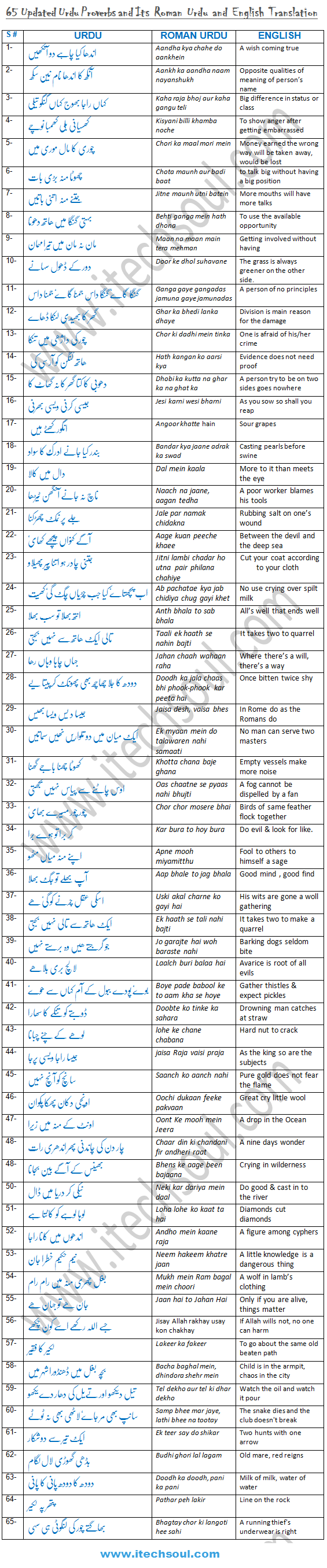
Today, we're launching new upgrades to this feature, so that it's even more useful. Whenever you type a word, phrase or sentence in english – we send API request to Lingvanex engine for a translation. In return, they translation service Lingvanex send back a response with a translated text in Urdu.

Of course I grant that Google Translate sometimes comes up with a series of output sentences that sound fine . A whole paragraph or two may come out superbly, giving the illusion that Google Translate knows what it is doing, understands what it is "reading." In such cases, Google Translate seems truly impressive—almost human! Praise is certainly due to its creators and their collective hard work. But at the same time, don't forget what Google Translate did with these two Chinese passages, and with the earlier French and German passages.

To understand such failures, one has to keep the ELIZA effect in mind. The bai-lingual engine isn't reading anything—not in the normal human sense of the verb "to read." It's processing text. The symbols it's processing are disconnected from experiences in the world. It has no memories on which to draw, no imagery, no understanding, no meaning residing behind the words it so rapidly flings around. For decades, sophisticated people—even some artificial-intelligence researchers—have fallen for the ELIZA effect. Google Translate is all about bypassing or circumventing the act of understanding language.

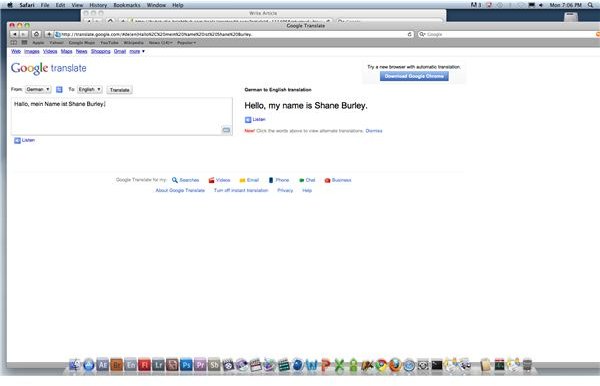
Let's say you want an Italian translation of an English phrase. Tap the name of the current language on the top-left side of the screen and select English as the source language. Tap the name of the language on the top-right side of the screen and select Italian as the target language. Next, tap the field that says Tap to enter text and start typing the English word or phrase you wish to translate.

A friend asked me whether Google Translate's level of skill isn't merely a function of the program's database. He figured that if you multiplied the database by a factor of, say, a million or a billion, eventually it would be able to translate anything thrown at it, and essentially perfectly. Having ever more "big data" won't bring you any closer to understanding, because understanding involves having ideas, and lack of ideas is the root of all the problems for machine translation today. So I would venture that bigger databases—even much bigger ones—won't turn the trick. This process, mediated via meaning, may sound sluggish, and indeed, in comparison with Google Translate's two or three seconds a page, it certainly is—but it is what any serious human translator does.
This is the kind of thing I imagine when I hear an evocative phrase like deep mind. To me, the word translation exudes a mysterious and evocative aura. Whenever I translate, I first read the original text carefully and internalize the ideas as clearly as I can, letting them slosh back and forth in my mind. It's not that the words of the original are sloshing back and forth; it's the ideas that are triggering all sorts of related ideas, creating a rich halo of related scenarios in my mind. Needless to say, most of this halo is unconscious.

Only when the halo has been evoked sufficiently in my mind do I start to try to express it—to "press it out"—in the second language. I try to say in Language B what strikes me as a natural B-ish way to talk about the kinds of situations that constitute the halo of meaning in question. Another cool feature is the ability to translate text in an image via your phone's camera. Choose the source and target languages, then tap the camera icon. Aim your device's camera at the sign, menu, or document written in the source language.

Translate typed text among more than 100 different languages, see translations of images in around 90 languages, translate bilingual conversations on the fly in 43 languages, and draw text for translation in 95 languages. Offline translations are also available for many languages, and you can also save translated words and phrases for future use. Google Translate does not apply grammatical rules, since its algorithms are based on statistical or pattern analysis rather than traditional rule-based analysis. The system's original creator, Franz Josef Och, has criticized the effectiveness of rule-based algorithms in favor of statistical approaches. Original versions of Google Translate were based on a method called statistical machine translation, and more specifically, on research by Och who won the DARPA contest for speed machine translation in 2003.

Och was the head of Google's machine translation group until leaving to join Human Longevity, Inc. in July 2014. When traveling abroad, especially in a region with multiple languages, it can be challenging for people to determine the language of the text that they need to translate. We took care of that—in the new version of the app, you can just select "Detect language" as the source language, and the Translate app will automatically detect the language and translate. Say you're traveling through South America, where both Portuguese and Spanish are spoken, and you encounter a sign. Translate app can now determine what language the sign is in, and then translate it for you into your language of choice. As explained earlier, the machine-language technology is used to perform the translation.




No comments:
Post a Comment
Note: Only a member of this blog may post a comment.